
Multi-location businesses face a reality most operators miss: 61% of employees would leave their current job for a company with better culture. The problem gets worse when you're managing teams across different locations. Research from SHRM shows that while 82% of executives rate their culture as good or excellent, only 47% of individual contributors agree. That gap is a major problem for multi-location leadership.
This disconnect costs real money for restaurants, retail stores, healthcare facilities, or service operations running multiple sites. Workers in positive organizational cultures are almost four times more likely to stay with their employer. Turnover among frontline workers already runs 35-50% in most industries. When culture falls apart across locations, those numbers get worse fast.
The challenge gets clearer when you look at frontline communication. While 65% of frontline leaders believe they have effective communication strategies, only 35% of frontline workers feel heard. Another study found that 62% of executives think their communication is effective, but only 39% of frontline employees agree. When your operations team sits in corporate and your workers clock in across five or fifteen or fifty locations, that gap becomes a canyon.
Why culture breaks down across multiple locations
The mechanics of culture breakdown in multi-location businesses follow predictable patterns. BrightLocal's 2024 research found that 23% of multi-location marketing teams rated their ability to manage the adoption of initiatives and streamline communications as just fair to poor. The breakdown happens between HQ and location level, where 82% of organizations believe they're good at managing internal communications, but messages don't land as intended further down the chain.
Communication fragmentation creates the first crack. Multi-location businesses often scatter information across email, text messages, phone calls, bulletin boards, and shift handoffs. A 2024 survey found that 24% of frontline workers still rely on noticeboards for information, while only 21% have access to a company intranet. When critical information about company values, recognition, or policy updates gets lost between locations, culture stops being something everyone experiences and becomes something only certain teams understand.
The second breakdown comes from inconsistent management approaches. Research from SHRM shows that 76% of employees believe their manager establishes the culture of their workplace. When each location has a different manager interpreting company values differently, you don't have one culture. You have five or ten or twenty different micro-cultures, some healthy and some toxic, all operating under the same brand name.
Frontline workers face unique barriers that office-based employees never encounter. Workers who must be onsite have 29% lower engagement than those with hybrid or remote flexibility. Only 23% of frontline workers report having access to digital tools they need, and 37% say fractured communication is very challenging to their daily work. When technology investments flow toward corporate offices while frontline teams make do with outdated systems, the message about who matters lands loud and clear.
Deloitte's 2024 research on microcultures adds another dimension. Nearly three-quarters of respondents say that focusing on individual teams and workgroups is the best place to cultivate culture. Location-specific teams naturally develop their own norms, symbols, and behaviors. The question isn't whether microcultures will form. The question is whether those microcultures align with your company's core values or drift away from them.
What actually builds culture across locations
Culture doesn't happen by accident, and it doesn't spread through inspirational posters or annual meetings. But there are some practical things you can do to create a cross-location culture.
Start with clarity on non-negotiable values. Your franchise documents might outline brand standards, but culture values need to be explicit. What behaviors get rewarded? What behaviors get shut down immediately? When a location manager faces a scheduling conflict between profit and fairness, which value wins? Until these answers are clear and consistent across every location, you're asking each manager to interpret company culture based on their own judgment.
One multi-location pet boarding business found that using multiple communication methods including Google Hangouts, email, text, phone, and sticky notes meant nobody knew what mattered most. After implementing a unified platform, they achieved 100% adoption and dramatically increased transparency regarding critical issues. The tool mattered less than the commitment to making information equally accessible to everyone.
Recognize that your frontline managers make or break culture. Research consistently shows that 70% of frontline managers want more training to do better in their jobs but aren't receiving it. At the same time, 53% of frontline managers report feeling burned out. When managers are overwhelmed and undertrained, they can't build the culture you want. They're too busy trying to cover shifts and handle customer complaints.
A Bay Area automotive business with 5 locations reduced annual employee churn by 43% after implementing unified communications, announcements features, and group messaging that connected owners, managers, and employees across all locations. The key wasn't just technology. It was that employees started reporting operational and HR issues because they finally had a channel to do it, which led to better team morale.
Make recognition visible across all locations. If leaders listen to feedback, 89% of frontline workers report they will stay with their companies. But recognition needs to be specific, timely, and visible. When a team member in Location 3 solves a customer problem brilliantly, do employees in Locations 1, 2, and 4 hear about it?
One Wendy's franchise group managing 15+ locations and 500+ team members uses announcements and recognition tools to boost team morale and reduce employee churn. Birthday celebrations and achievement recognition that might seem small create cultural touchpoints that employees remember. These employee rewards are proof that the company notices people.
Create feedback loops that actually work. According to Axonify's 2024 Deskless Report, 33% of employees say they rarely or never receive direct feedback. When feedback only travels downward, culture becomes something done to employees instead of something built with them. Two-way communication enhances engagement, allowing frontline workers to give feedback and feel more connected to organizational goals.
The mechanics matter. If feedback requires scheduling meetings, filling out lengthy forms, or waiting for quarterly reviews, it won't happen. If managers can't easily send updates or employees can't quickly flag issues, the communication gap widens. One automotive service business reduced the number of staff meetings from every day to three times a week (a 40% reduction) after implementing better communication channels, because they stopped needing constant check-ins to stay aligned.
The role of consistent communication infrastructure
Here's what multi-location operators learn fast: you can't build culture without infrastructure that supports it. When a Taco Bell rollout reached 30,000+ team members across 1,000+ locations, frictionless onboarding and dedicated support enabled quick deployment with an average two-day onboarding time and 90% weekly usage. The infrastructure created the conditions for culture to take root.
The infrastructure needs in multi-location businesses differ from corporate offices. Frontline workers don't sit at desks checking email. According to Pew Research, a quarter of adults with household income below $30,000 don't own smartphones. When your communication strategy assumes everyone has a work email and a desktop computer, you've already excluded a significant portion of your workforce.
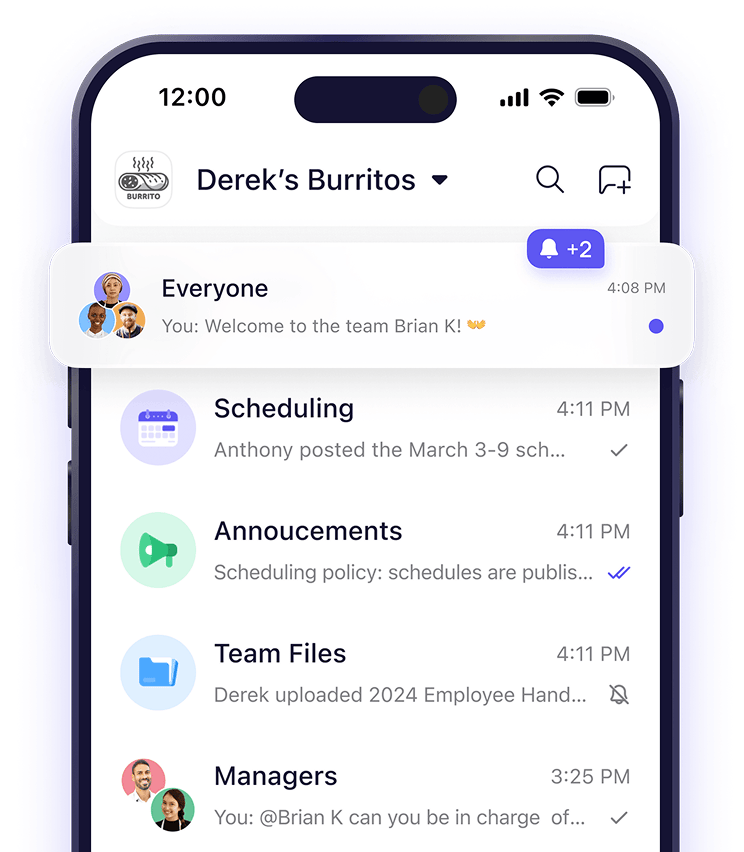
Mobile-first communication platforms give frontline workers access on the devices they actually use. The benefits compound quickly. Schedules become instantly accessible instead of requiring employees to visit the location to check a posted paper schedule. Shift swaps can happen through self-serve capabilities with manager approval instead of requiring phone tag across multiple people. Real-time updates reach everyone simultaneously instead of relying on managers to relay information through shift handoffs that inevitably distort the message.
What strong multi-location cultures look like in practice
The difference between scattered culture and strong culture shows up in measurable outcomes. Workers in positive organizational cultures are significantly more likely to feel satisfied at work. Just 15% of employees who rate their culture as good or excellent are actively looking for new jobs, compared to 57% of those who rate their culture poorly.
Strong cultures in multi-location businesses create systems where location managers can efficiently communicate with both their teams and corporate leadership. They also make onboarding consistent across all locations. Beyond that, they empower location managers without creating complete autonomy.
The mistake many multi-location operators make is thinking culture will naturally replicate itself as they expand. It won't. Culture requires deliberate systems, consistent reinforcement, and infrastructure that supports it. When 88% of workers say corporate culture is important when choosing where to work, and when 69% of Gen Z employees prefer positive company culture over a high paycheck, culture becomes a competitive advantage in hiring and retention.
Making culture stick requires ongoing attention
Building culture once isn't enough. Research shows that 80% of respondents believe their organization's culture must evolve in the next five years for their company to succeed, grow, and retain the best people. Yet 23% of employees report that their organizations' leaders have attempted culture change with no noticeable results.
The gap between executive perception and employee reality persists across companies. Globally, executives are 82% likely to rate their culture as good or excellent, while individual contributors rate it at only 47%. The culture leaders think they've built clearly hasn't reached everyone.
For multi-location businesses, the path forward requires three commitments. First, invest in communication infrastructure that actually reaches frontline workers. Bulletin boards and shift handoffs won't cut it when 86% of frontline workers say they need training in new technologies for their jobs but only 14% report receiving it. Second, give location managers the training and support they need to build culture locally while staying aligned with company values. Third, create feedback mechanisms that let you know when culture drifts at specific locations before turnover spikes and customer satisfaction drops.
The cost of ignoring culture across multiple locations shows up in turnover, customer service quality, and profitability. Research from SHRM found that the cost of turnover due to workplace culture exceeded $223 billion over five years. For multi-location operators, that cost gets multiplied across every site where culture breaks down.
When culture works across all your locations, employees stay longer, work harder, and care more about outcomes. Disengagement costs the global economy an estimated $8.8 trillion annually, but businesses that build strong cultures capture that value instead of losing it. Ultimately, the question is whether you're building culture intentionally across every location or leaving it to chance.