
This article provides general information about employment law and BYOD policies. It is not legal advice and should not be relied upon as such. Employment laws vary by state and individual circumstances. For specific guidance about your situation, consult with a qualified employment attorney in your jurisdiction.
When we talk to businesses considering communication platforms for their teams, some managers worry that they're breaking a law by asking their staff to download an app. We've heard managers say things like "isn't it illegal to make employees use their personal phones?" or "won't we get sued if we require this?"
The short answer: requiring employees to download work apps on their personal phones is legal in the United States. The longer answer involves understanding what employers actually need to do to stay compliant, because the real legal issue isn't about permission to require the app. It's about reimbursement.
What the Law Actually Says
No federal statute prohibits employers from requiring employees to use personal devices for work purposes. Under at-will employment (the standard in all U.S. states except Montana), employers can set conditions of employment including the tools and technology employees must use to do their jobs.
Here's what employment attorneys consistently tell workers who ask about this: yes, your employer can require you to download a work app on your personal phone, and yes, they can terminate your employment if you refuse. The catch is that in many states, if they require it, they also have to pay for it.
The Reimbursement Requirement Most Managers Miss
The Cochran v. Schwan's Home Service case in California settled this question definitively in 2014. The Second Appellate District ruled that when employees must use personal cell phones for work-related purposes, employers must reimburse them for "a reasonable percentage" of their phone bills. This applies even if the employee has an unlimited plan and didn't incur any additional out-of-pocket costs.
When the employer petitioned the California Supreme Court to review the case, the court denied the petition in November 2014, letting the appellate ruling stand. The Supreme Court also denied a request to unpublish the case, meaning it remains binding precedent in California.
The appellate court's reasoning was clear: "Does an employer always have to reimburse an employee for the reasonable expense of the mandatory use of a personal cell phone, or is the reimbursement obligation limited to the situation in which the employee incurred an extra expense that he or she would not have otherwise incurred absent the job? The answer is that reimbursement is always required."
The principle: employers can't pass their operating expenses onto their employees. The court reasoned that without this rule, "the employer would receive a windfall because it would be passing its operating expenses onto the employee". If using a personal phone is necessary to do the job, the expense becomes reimbursable under California Labor Code Section 2802.
This matters for communication apps because downloading and using a scheduling or messaging platform on a personal phone counts as work-related use. The data consumed by the app, the notifications received during off-hours, the storage space it occupies, and the basic expectation of availability all constitute business use of a personal device.
Which States Require Reimbursement
Eleven states, Washington D.C., and Seattle have laws requiring employers to reimburse employees for work-related expenses. The specifics vary:
California and Illinois have the strictest requirements. These states mandate reimbursement for all necessary business expenses without qualifiers.
In California, Labor Code 2802 requires employers to reimburse "all necessary expenditures or losses incurred by the employee in direct consequence of the discharge of his or her duties." Courts have interpreted this broadly to include texts, emails, app notifications, and any communication that travels through a device the employee pays for.
In Illinois, the Wage Payment and Collection Act (Section 9.5, effective January 2019) requires employers to reimburse "all necessary expenditures or losses incurred by the employee within the employee's scope of employment and directly related to services performed for the employer". The law was modeled directly after California's statute and carries a similar interpretation.
Other states with reimbursement requirements include:
- Iowa: Reimbursement required for authorized expenses (Iowa Code 91A.3(6))
- Massachusetts: Required if expenses would drop wages below minimum wage
- Minnesota: Required upon termination for certain work-related expenses (Minnesota Statute 177.24)
- Montana: Broad language covering necessary expenses (Montana Administrative Rule 24.29.720)
- New Hampshire: Required within 30 days of employee request (New Hampshire Revised Statutes 275:57)
- North Dakota and South Dakota: General expense reimbursement requirements
- Washington D.C.: Covers "tools required of the employee in the performance of the business" (D.C. Municipal Register Title 7 Section 910.5)
New York and Pennsylvania have different rules. These states only require reimbursement if it's explicitly promised in a policy, contract, or collective bargaining agreement. Once promised, failing to reimburse becomes a violation.
Federal law provides baseline protection. The Fair Labor Standards Act requires reimbursement only if work-related expenses drop an employee's effective wage below federal minimum wage. For minimum wage workers, unreimbursed phone expenses could create FLSA violations.
What Counts as "Reasonable" Reimbursement
The most common question managers ask: how much do we actually have to pay?
California courts established that employers must reimburse a "reasonable percentage" of the employee's phone bill based on work-related usage. This doesn't mean tracking every single message or call. Employers can establish a flat monthly stipend, reimburse a percentage of the bill, or create tiered reimbursement based on job role.
Common approaches include:
- Flat stipend: A set amount per month (typically $20-50) for all employees who use personal devices for work
- Percentage reimbursement: Employees submit their phone bills, and the employer reimburses an estimated percentage of work use
- Tiered system: Different amounts based on role (managers might get $50/month, hourly employees $25/month)
- Actual use: Employees document work-related usage and submit for reimbursement within 30 days
The key is that the reimbursement must reasonably reflect business use. Paying $5/month when employees are expected to use messaging and scheduling apps multiple times daily wouldn't meet the "reasonable percentage" standard.
When Reimbursement Isn't Required
There are legitimate scenarios where employers don't need to reimburse for app usage:
The employer provides an alternative. If employees can opt to use a company-provided device instead, and personal phone use is truly optional, reimbursement isn't mandatory. The California courts have been clear: if employees can decline using their personal device and still perform their job using employer-provided tools (work phone, kiosk, desktop portal), any personal phone expense becomes unnecessary.
The employer pays 100% of the phone plan. If the company covers the entire cost of the employee's phone service, there's nothing left to reimburse.
Personal use only. Messages and communications that are purely personal and unrelated to job duties don't trigger reimbursement requirements.
Voluntary remote work. Courts have found that when working from home is entirely optional and employees could work on-site with company-provided equipment, home office expenses may not be "necessary".
The Privacy Concern Managers Should Actually Worry About
The objection that requiring apps is "invasive" has merit, but it's about implementation rather than legality. Employees have legitimate concerns about:
- Data access: What personal information can the employer see?
- Off-hours monitoring: Will managers track their location or activity during personal time?
- Personal data security: What happens to their photos, contacts, and messages if the company remotely wipes the device?
These concerns are real and deserve thoughtful Bring Your Own Device (BYOD) policies. Research shows that 90% of security leaders cite safeguarding corporate data while preserving employee privacy as their top priority.
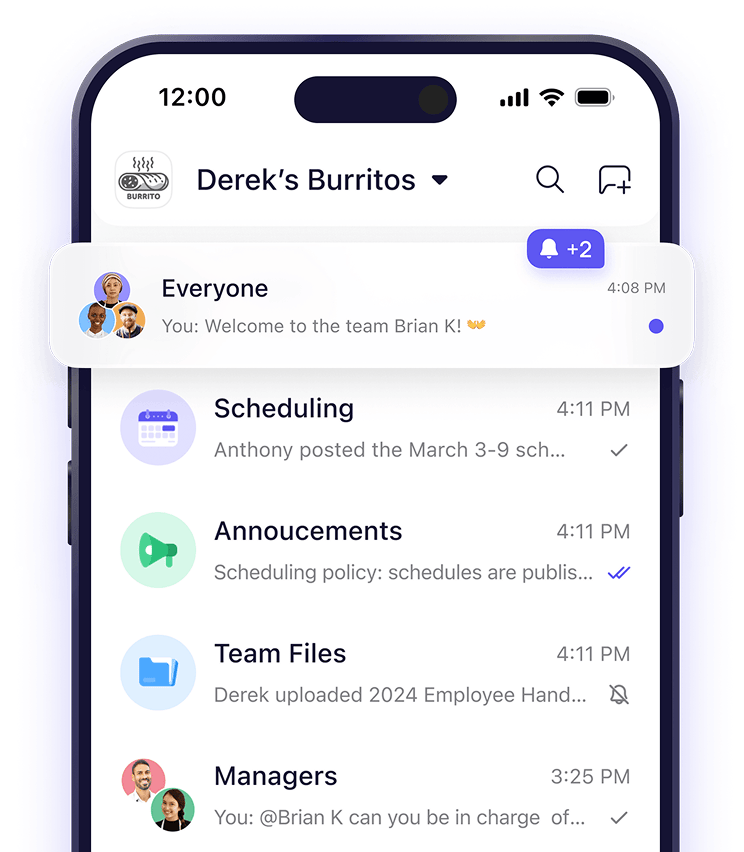
Modern workforce communication platforms designed for frontline teams typically request minimal permissions: the ability to send notifications, access the camera (for uploading photos), and run in the background. They don't access your personal contacts, read your text messages, or track your location unless you're using a specific clocking feature.
This differs significantly from MDM (Mobile Device Management) software that some large enterprises use, which can monitor GPS location, install security policies, and remotely wipe devices. For small to mid-sized businesses in restaurants, retail, healthcare, and similar industries, basic communication apps function more like consumer apps than invasive monitoring tools.
How to Implement App Requirements Legally
If you're a manager considering requiring your team to use a communication or scheduling app, here's how to do it right:
1. Create a Written BYOD Policy
In your Employee Handbook, document what you're asking employees to do, which apps are required, what reimbursement you'll provide, and what data the company can and cannot access. Employees should sign an acknowledgment that they've read and understood the policy.
Your policy should address:
- Which devices and operating systems are supported
- Required security measures (passcode protection, OS updates)
- What constitutes acceptable use
- How reimbursement works and how to request it
- Data ownership (company data belongs to the company)
- What happens when employees leave
- Privacy protections for personal data
- No retaliation for choosing company devices over BYOD
2. Provide Reimbursement Proactively
Don't wait for employees to ask. If you're in California, Illinois, or another state with mandatory reimbursement, build it into your payroll from day one. Even if you're in a state without specific requirements, providing a cell phone stipend demonstrates that you value employees' resources.
Document the reimbursement separately from wages. The IRS allows cell phone reimbursements to be tax-free if they're for legitimate business purposes, properly documented, and don't exceed reasonable amounts.
3. Make It Actually Optional (or Admit It's Required)
The biggest mistake is claiming personal phone use is "optional" while making it functionally impossible to do the job without it. If you're going to send schedule updates, shift change notifications, and urgent messages through an app, you're requiring its use. Own that and compensate accordingly.
If you genuinely want it to be optional, provide real alternatives: a kiosk or tablet in the workplace where employees can check schedules, a work phone they can check out, or a desktop portal they can access during their shift.
4. Respect the Boundary Between Work and Personal Time
Just because employees have a work app on their phone doesn't mean they're on call 24/7. Make clear expectations about response times outside scheduled shifts. California and federal law requires that hourly employees be paid for all time worked, including reading and responding to work messages outside scheduled hours.
Some states have "right to disconnect" protections emerging. Setting boundaries protects both the employee's work-life balance and your company from off-the-clock wage claims.
5. Address Data Privacy Explicitly
Tell employees exactly what data the app can access. Most communication apps need:
- Notification permissions (to alert about new messages)
- Camera access (to upload photos)
- Storage access (to save and send documents)
They typically don't need and shouldn't request:
- Access to personal contacts
- Ability to read other apps' data
- Location tracking (except for specific clock-in features that employees knowingly use)
If you're using MDM software for device management, disclose this clearly. Explain what can be monitored, what triggers remote actions, and what happens if the device is lost or the employee leaves.
What About Employees Who Refuse?
In at-will employment states (which is everywhere except Montana), employers can terminate employees who refuse to comply with job requirements, including technology requirements. However, smart managers consider why employees are refusing.
Common legitimate concerns:
- Cost: The employee can't afford data overages or doesn't have a smartphone
- Privacy: Previous bad experiences with invasive employer monitoring
- Technical: Their phone is too old to support the app or lacks storage space
- Personal: They don't want work interrupting family time
Many of these have straightforward solutions:
- For cost concerns, provide a stipend or company device
- For privacy concerns, show exactly what permissions the app requests and provide written policies
- For technical limitations, offer a company tablet or access through a work computer
- For work-life balance concerns, establish clear expectations about after-hours communication
Terminating an employee for refusing to download an app is legal, but it might not be necessary. Understanding the underlying concern often leads to a solution that works for everyone.
The NLRA Angle That Sometimes Surprises Managers
The National Labor Relations Act protects employees' rights to engage in "concerted activity" regarding terms and conditions of employment. This applies to both union and non-union workplaces.
If employees collectively object to a new app requirement or organize to request reimbursement, that's protected activity. Retaliating against employees for discussing wages, working conditions, or technology requirements together could violate federal labor law.
This doesn't mean you can't require the app. It means you can't discipline employees for talking to each other about concerns regarding the requirement or for approaching management as a group to request changes.
State-by-State Quick Reference for Reimbursement
Mandatory reimbursement for all necessary business expenses:
- California
- Illinois
- Iowa
- Montana
- Washington D.C.
Reimbursement required if it drops wages below minimum wage:
- Massachusetts
- All states under federal FLSA
Reimbursement required if authorized or upon termination:
- Minnesota (upon termination)
- Iowa (if authorized)
- New Hampshire (within 30 days of request)
Reimbursement required only if promised in writing:
- New York
- Pennsylvania
No specific state requirement (federal FLSA minimum wage protection applies):
- All other states
Even in states without specific requirements, providing reasonable reimbursement is a best practice that demonstrates respect for employees' resources and reduces turnover.
What This Means for Shift-Based Businesses
For restaurants, retail stores, healthcare facilities, automotive service centers, and similar industries, communication and scheduling apps solve real operational problems. Managers need ways to notify employees about schedule changes, find coverage for no-shows, broadcast urgent updates, and keep everyone informed across multiple locations.
The question isn't whether these tools are valuable. The question is how to implement them fairly.
The legal path forward is clear:
- Yes, you can require employees to download and use work apps on personal phones
- Yes, you need to reimburse them for that use in most states
- Yes, you need written policies that address privacy and data security
- Yes, you need to respect work-life boundaries even with instant communication
The businesses that handle this well don't just avoid legal problems. They also get better adoption, less resistance, and more engaged teams. Employees who feel their personal resources and privacy are respected are more likely to actually use the tools effectively.
When employees push back on downloading a work app, it's rarely about the app itself. It's about uncertainty: Will this cost me money? Will my boss track my location on weekends? Will I be expected to respond to messages at 11pm? Can my employer see my personal photos?
Clear policies that address these concerns head-on make the entire conversation easier. Instead of "you have to download this," it becomes "here's how this tool helps everyone, here's the $30/month stipend to cover it, here's exactly what we can and can't access, and here's when you're expected to check it."
The Bottom Line
Requiring employees to download work apps on their personal phones is legal. Failing to reimburse them for that use in states with expense reimbursement laws is not. Invading their privacy without clear policies and consent is asking for trouble. Pretending they're on-call 24/7 without paying for that time creates wage and hour violations.
The objection that "we can't require employees to use apps" often comes from managers who know something feels legally uncertain but can't pinpoint what. Now you know: the uncertainty is about doing it right, not about whether you can do it at all.
Implement clear BYOD policies, provide reasonable reimbursement, respect privacy boundaries, and maintain work-life balance expectations. That's the legal framework. Everything else is just good management.