
The email announcing your new employee platform looked great. Leadership talked about unified communications, streamlined operations, better engagement. The screenshots showed sleek dashboards with graphs and tabs and all the features everyone wanted.
Then you checked the usage data six months later.
Office workers logged in regularly from their computers. Frontline employees? Barely touched it. A recent report found that 99% of employees access SharePoint via desktop, while only 0.22% access the intranet on their phone and 0.02% by tablet. Your $50,000 platform investment reached exactly the people who already had access to communication tools.
The business case for mobile workforce technology isn't about adding another app. It's about recognizing that the US mobile worker population reached 93.5 million in 2024, representing nearly 60% of the workforce. Your employees already work on mobile devices. The question is whether your systems acknowledge that reality.
The desktop assumption that kills adoption
Most enterprise software gets built with a specific user in mind: someone sitting at a desk, using a mouse and keyboard, with a large screen and consistent internet access. That person exists. They're just not the majority of your workforce.
Frontline workers account for over 80% of the global workforce, and they are largely deskless. They work in environments where desktop access ranges from difficult to impossible. Warehouse workers moving inventory, retail associates helping customers, healthcare staff moving between patient rooms, restaurant employees handling rush periods. When they do have computer access, it's typically a shared terminal in a break room that five other people are waiting to use.
The result? Only 23% of frontline workers report having access to the digital tools they need to stay productive. That's not because the tools don't exist. It's because the tools assume a work environment that doesn't match their reality.
Frontline workers who undertake training on their mobile phones complete it 45% faster than those who learn on a desktop. The speed difference isn't about mobile being inherently better technology. It's about accessibility. Desktop training requires frontline workers to stop what they're doing, leave their work area, find an available computer, log in, and hope nobody interrupts them. Mobile training happens whenever they have three minutes between tasks.
What "mobile-first" actually means (and doesn't)
There's confusion about what mobile-first employee apps actually are. It's not just making your desktop software responsive so buttons don't break on smaller screens. It's not creating a stripped-down version of your full platform that removes features "mobile users don't need."
Mobile-first means the mobile experience is the primary design target, with desktop as the secondary consideration. Every feature, every workflow, every interaction gets designed for someone holding a phone with one hand while doing something else.
One of the first barriers is simply enrolling users: what do you do when you can't send people a link because they don't have a work email account? Mobile-first platforms solve this with QR codes employees can scan, single-use codes sent by SMS, or delegation to shift leaders who can manage team access. Desktop platforms assume everyone has corporate email and can click a link.
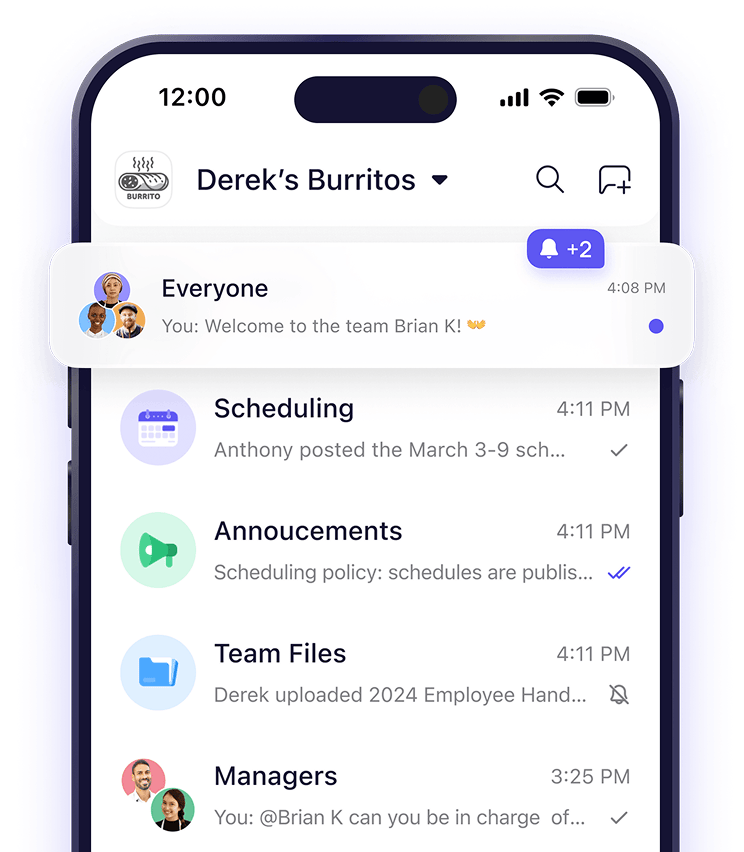
A second major challenge is that frontline workers have very limited screen time. In some cases, you may ban phones from the workplace, particularly while driving or in front of customers. Mobile-first design strips interfaces back to essentials, using sections like "To know" and "To do" instead of complex navigation requiring multiple clicks to find anything useful.
This Taco Bell deployment using Breakroom Chat demonstrates this principle. With 30,000+ team members across 1,000+ locations, they needed tools that work for employees who don't sit at computers. Shift coverage requests, food transfer coordination, schedule changes, time-off requests all happen through mobile interfaces designed for quick access between customer interactions.
The adoption gap nobody talks about
Here's the uncomfortable reality: your technology adoption rate predicts its ROI, and most enterprise software gets abysmal adoption from frontline workers.
In North America, 75% of organizations have frontline workers sharing mobile devices, yet most employee platforms require individual logins and don't account for shared device scenarios. Frontline mobile workers now rely on an average of five or more unique applications to support their work, marking an over 80% increase in the past 24 months. Every additional app requiring separate login credentials reduces usage.
The friction compounds. Phones may be banned from the factory floor, while driving, or in front of customers, making it extra important for the app to deliver simple, effective information. If checking the schedule requires opening an app, navigating three menus, and loading a slow-rendering calendar, employees just won't do it. They'll text each other instead.
The ROI that actually matters
Mobile workforce technology market growth reflects real business value, not hype. Companies don't spend billions on technology that doesn't deliver returns. The measurable ROI breaks down across several dimensions:
Productivity gains. Companies rated by employees as "pioneers" in how they support mobile technology saw a rise in productivity of 16%, creativity of 18%, satisfaction of 23%, and loyalty of 21% when compared to organizations poorly rated at supporting mobile technology. Those aren't marginal improvements. They're the difference between competitive operations and industry leadership.
Turnover reduction. Companies utilizing an employee app were found to drive engagement levels above 75%, which can save them anywhere from 25 to 65% on turnover costs according to Harvard Business Review. When you consider that replacing an hourly employee typically costs thousands of dollars in hiring, training, and lost productivity, the savings become substantial fast.
Communication efficiency. Better internal communications can generate productivity gains, but those gains only materialize if your communication tools reach everyone. Announcements sent via desktop portals don't reach employees who rarely log into computers.
A 101 Express case study illustrates combined ROI: 43% reduction in employee churn, hours saved on scheduling reduced to minutes weekly, improved compliance across all locations, better decision-making through unified communications. None of those outcomes happen with desktop-only platforms that half your workforce can't realistically access.
Why enterprise platforms fail frontline workers
The failure pattern is predictable. Leadership selects enterprise software based on features that matter to office workers like them: integration with desktop applications, complex reporting dashboards, extensive customization options. The vendor demonstrates the platform on a large monitor with a mouse and keyboard. Everyone agrees it looks great.
Then you try getting a warehouse worker to use it on their phone during a 15-minute break.
Most ERP systems are built for office environments, with complex dashboards designed for big screens and mouse clicks, but warehouse staff, retail clerks, and delivery drivers aren't sitting at desks. Tiny buttons, endless menus, and non-responsive interfaces turn simple tasks into frustration.
The integration trap makes things worse. Enterprise platforms promise to unify everything under one system, which sounds efficient until you realize frontline workers don't need 14 tabs to check inventory or 12 clicks to see next week's schedule. They need role-specific interfaces that let them complete common tasks in one or two taps.
The BYOD reality and security theater
The bring-your-own-device trend isn't new, but many organizations treat it as a security problem rather than an adoption opportunity. Certainly, the security concerns are legitimate. But blocking mobile access entirely doesn't solve security issues. It just pushes communications into even less secure channels like personal text messages and unmanaged group chats.
The privacy angle compounds adoption challenges. Privacy and security concerns are very real among blue-collar BYOD users. Fears of tracking, data misuse, and blurred boundaries can slow adoption. When employees don't trust that work apps won't monitor their personal activities, they resist installation. Tackling this head-on with transparency, privacy safeguards, and clear policies is essential.
The solution isn't avoiding mobile. It's implementing mobile-first platforms with appropriate security that doesn't create friction for legitimate use. Multi-factor authentication that works smoothly on mobile. Role-based access that doesn't require sharing passwords on shared devices. End-to-end encryption for sensitive communications. Security that protects without preventing actual work.
What successful implementation looks like
The common thread in successful mobile workforce technology deployments is user-centered design, not feature accumulation.
Start with actual use cases. Not "how do we give frontline workers access to our systems" but "what do frontline workers actually need to do, and how can mobile tools make that easier?" When Coastal Calibration reduced staff meetings by 40%, it wasn't because they added meeting features. It was because mobile communications replaced the need for many meetings entirely.
It's important to train users for digital tools they need in their job. This training should happen on the employee's device, and for frontline workers, that often means a mobile device. Hands-on simulation in the actual app works better than classroom training on desktops. According to the Ebbinghaus Forgetting Curve, without reinforcement, people forget 40% of their training after a few days and 90% after a month. Mobile-first platforms enable on-demand reference materials accessible whenever employees need refreshers.
Enrollment matters more than vendors acknowledge. Employee app vendors use QR barcodes employees can scan, single-use codes sent by mail or SMS, or delegation of access management to shift leaders. The method matters less than eliminating barriers. If your enrollment process requires an employee to remember a 16-character password or reset credentials through an email account they check monthly, adoption fails before it starts.
Meaningful usage doesn’t just include how many people downloaded the app, but how many actively use it weekly. Not just whether the platform has features, but whether employees can complete common tasks without help. Not just initial rollout success, but sustained usage six months later.
The demographic myth
One persistent misconception: older workers won't adopt mobile technology, so don't bother optimizing for mobile.
The 101 Express success with employees ages 20-70 demonstrates why this assumption is wrong. When the interface is simple enough, when the value is clear enough, when the friction is low enough, age becomes irrelevant. People of all ages use smartphones for banking, shopping, navigation, and dozens of other complex tasks. They can use them for work if the tools are designed properly.
The real barrier isn't age. It's a bad design that assumes technical sophistication. Users increasingly want things that are more self-guided, and hands-on simulation is much more effective than just visually showing someone how to use a tool. An app that requires reading a manual has already failed.
The cost of waiting
Companies investing now in mobile tools establish competitive advantages. Companies waiting will lose ground to competitors with better-connected frontline teams.
The opportunity cost compounds. Gallup's 2024 research estimates disengaged employees cost the global economy a staggering $8.8 trillion annually. Every month your frontline workers remain digitally disconnected, you're paying that disengagement tax.
Meanwhile, your competitors are solving the same problems you face. They're reducing turnover, improving safety, streamlining operations, engaging employees. The gap widens.
The business case for mobile-first employee apps isn't about technology trends. It's about operational reality. Your frontline workers already use mobile devices for everything else in their lives. The question is whether your business systems will meet them where they work, or continue assuming everyone has a desk and a computer.