
You handled scheduling for 10 employees in your head. Now you have 30 across two locations, and you're spending entire afternoons just trying to figure out who works when. Sound familiar?
The employee scheduling software market tells the growth story clearly. The sector is expected to expand from $1.85 billion in 2024 to a projected $5.41 billion by 2033. That’s thousands of businesses discovering that manual scheduling can’t scale.
Managing a growing workforce can be the difference between controlled expansion and chaos. About one in four U.S. employees face schedule unpredictability, and 41% have little or no control over when they work. Without effective scheduling systems, these problems amplify. Turnover accelerates, compliance risks multiply, and managers burn out.
When manual scheduling stops working
Most businesses hit their breaking point with scheduling between 20 and 50 employees. At 10 employees, a manager can remember who prefers morning shifts and who's trained on which stations. At 30, that mental model fails. Add a second location and the system collapses entirely.
The timeline is predictable. Week one of expansion: schedules get published late. Week four: the first overtime surprise hits payroll. Week eight: your top performer hands in their notice.
Every time an hourly employee quits, you're out $5,000 minimum. With the restaurant turnover rate typically hitting 70%, a 50-person team loses 35 employees a year. That's $175,000 walking out the door.
Manual scheduling creates hidden costs that growing businesses don't anticipate. Excel doesn't warn you when you're about to trigger overtime. Paper schedules can't notify people when shifts change. Text threads leave no record for audits.
Tracking who actually showed up across multiple locations becomes impossible manually. Research from Harvard Kennedy School’s Shift Project found unstable scheduling drives higher turnover and inefficiency. Manual systems provide this data only after damage is done, when payroll costs have gone over budget.
The majority of workers across industries are seeking schedule flexibility and work-life balance improvements. Gallup's State of the Global Workplace found over half of employees are actively job hunting, with 'work-life balance' ranking as a top reason for leaving. Growing businesses using inflexible manual scheduling methods lose top performers to competitors offering predictability.
The compliance trap nobody sees coming
Fair Workweek laws have been passed in major cities across the country and more are coming. If you have multiple locations or 500+ employees worldwide, these predictive scheduling laws already apply to you.
Here's what they require:
Post schedules 14 days in advance. Change someone's shift after that deadline? You owe them predictability pay. In Chicago, that's 1 hour of pay for changes made with less than 14 days notice, and up to 50% of their shift pay if you cancel less than 24 hours before they're supposed to work.
No clopening. You can't schedule someone to close at 11pm and open at 6am the next morning. Most jurisdictions require 10-11 hours between shifts. Break that “clopening” rule and you pay 1.25-1.5 times their regular rate, or face penalties like New York's $100 fine per violation.
Keep documentation for three years. Every schedule, every change, every consent form, every predictability payment needs to be tracked and stored. During an audit, "I think we paid them for that schedule change" doesn't count.
McDonald's franchises in Pittsburgh learned this the expensive way. They paid $57,332 in civil penalties when investigators found 100+ teens working excessive hours because nobody was tracking schedules properly. Similar violations hit Subway, Burger King, and Popeyes locations in 2023.
Without software that automatically tracks these requirements, you're building violations into every schedule you make. Most managers don't even know these laws exist until the penalty notice arrives.
Labor costs that sink growth plans
Labor costs are your biggest line item. If you're overstaffing slow periods by even one person per shift, you're burning thousands monthly. Understaffing rushes means lost sales you can't recover.
Inefficient schedules lead to overtime, understaffing, or burnout. Research from the University of Notre Dame reveals that employees struggle with boredom for an average of 10.5 hours per workweek, often resulting in suppressed productivity and higher turnover risk. Overstaffing creates situations where employees perform low-value tasks to fill time.
Technology that scales
You're looking at Thursday's schedule and realize you've got three closers but Friday night is understaffed. You fix it. Then Saturday breaks because now Jenny's hitting overtime. You fix that. Then someone calls out.
These are the features that save your skin:
- Demand-based scheduling analyzes historical sales, foot traffic, and appointments to determine optimal staffing levels. This prevents both understaffing that damages customer experience and overstaffing that wastes payroll dollars.
- Automated overtime alerts notify managers when scheduling someone for additional shifts would push them over threshold, allowing proactive adjustments before incurring unnecessary costs.
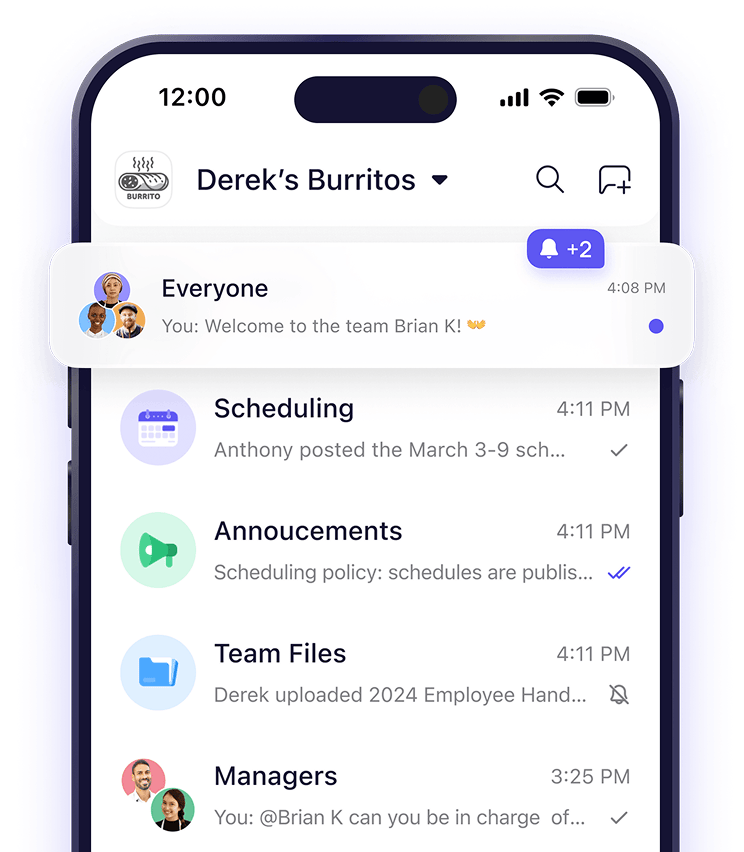
- Mobile schedule access ensures all employees can view schedules anytime from their devices. Self-serve shift swap capabilities with manager approval let employees coordinate coverage without manual coordination.
Case studies using these features demonstrate measurable returns:
One Wendy's franchise group faced exactly this problem across 15 locations. They achieved full compliance with Oregon's predictive scheduling law by implementing digital scheduling that automatically provided required 14-day advance notice. Beyond compliance, they reduced employee churn and boosted team morale.
A multi-location automotive business with 5 locations reduced annual employee churn by 43% after implementing unified communications and scheduling. The decrease in scheduling time translated to hours available for operations and customer service.
Making the transition
Technology alone doesn't solve scaling workforce management challenges. The most successful implementations combine technology deployment with process redesign and manager training.
The implementation journey follows a predictable path:
The assessment phase identifies current scheduling problems through manager interviews about time spent on scheduling, employee surveys about schedule satisfaction, analysis of overtime costs, and documentation of compliance violations or near-misses.
Technology selection focuses on must-have features rather than exhaustive capability lists. Growing businesses need solutions that handle current scale plus 3X growth headroom, deploy within weeks not months, integrate with existing payroll systems, and provide mobile access for frontline employees.
Manager training focuses on understanding scheduling's business impact rather than just system mechanics. Managers need to grasp how labor cost percentage affects profitability, how overtime erodes margins, and how understaffing damages customer experience.
The parallel operation period runs both old and new systems simultaneously for 2-4 weeks, allowing comparison and building confidence. Once accuracy and reliability are proven, the old system can be retired.
Common implementation mistakes include:
Underestimating training requirements, rushing deployment to solve the immediate crisis, choosing systems based on features rather than usability, failing to integrate with existing systems, and not allocating ongoing support resources.
The competitive advantage
The distinction between growing businesses that thrive and those that collapse often reduces to systems. Scheduling represents one infrastructure component that either supports or constrains growth.
The labor market reality magnifies scheduling's importance. With the Michael Page Talent Trends report indicating that 90% of the global workforce is open to new job opportunities, companies with poor scheduling lose top performers to competitors offering predictability and control.
Customer experience correlates directly with scheduling quality through optimal staffing during peak periods, reduced wait times, employee morale that shows in customer interactions, and consistency that builds loyalty. Understaffed businesses lose sales. Overstaffed businesses burn cash. Optimal scheduling delivers the right resources at the right times.
The strategic capacity that organizational excellence provides allows leaders to focus on growth rather than firefighting. When scheduling is organized and reliable, managers can concentrate on coaching employees, serving customers, improving operations, and executing expansion plans.
Growing businesses face countless challenges: finding customers, managing cash flow, hiring talent, maintaining quality, and executing strategy. Scheduling shouldn't be a problem that consumes leadership attention and constrains growth. With proper systems and processes, it becomes routine infrastructure that supports expansion. The businesses that recognize this early and invest in scheduling excellence position themselves for sustainable growth. Those that delay until chaos forces change pay unnecessary costs in turnover, compliance, and missed opportunities.