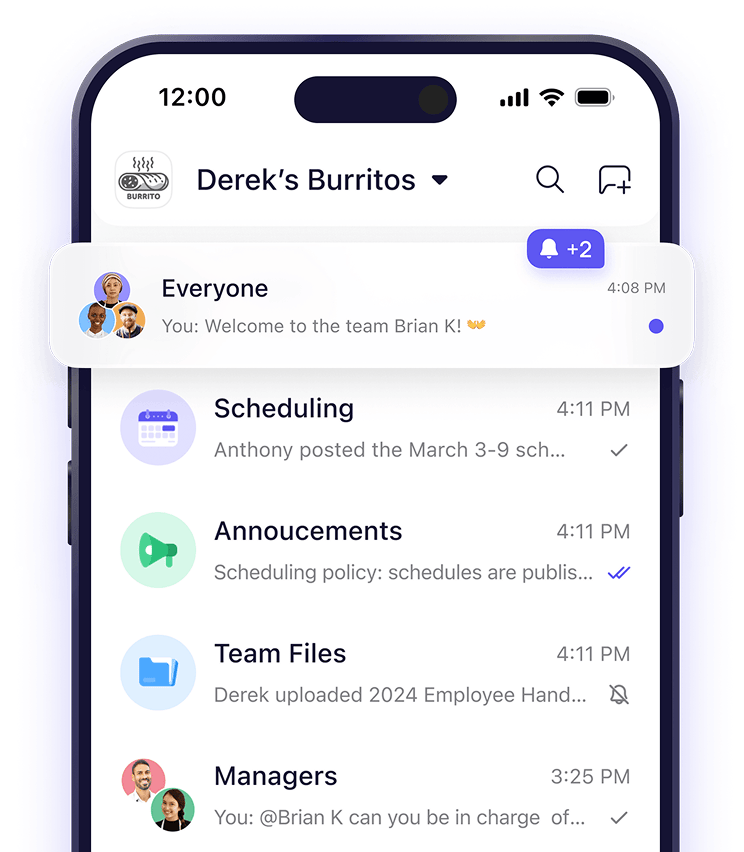

Running one salon is hard enough. Running three, five, or ten means dealing with the same problems multiplied across every location, except now you can't physically be everywhere at once.
The biggest issue isn't scheduling or inventory or even hiring. It's communication. "Communication is the hardest," one salon franchisee told us during a recent demo. When you can't walk fifteen feet to check on something, every small question becomes a text thread. Every update requires multiple phone calls. Every policy change needs to be explained separately to each location.
The Real Cost of Scattered Communications
Most multi-location salon owners start with personal cell phones. You text your managers, they text their stylists, everyone has everyone's number. It works fine until you hit about 15-20 people. Then the group chats become unmanageable. Messages get buried. Someone doesn't see the update about the new product line. A stylist misses the memo about holiday hours.
This creates real problems. A client books a balayage appointment at Location A expecting the promotional price that was only communicated to Location B. A stylist shows up for a shift that was already covered because the schedule change only went out in one group text. Product orders get duplicated because two managers didn't know the other had already placed it.
Each mistake erodes trust. Clients stop believing your promotions are consistent. Staff stop checking messages because there are too many to keep track of. Managers spend more time clarifying what they should be doing than actually doing it.
The Manager Time Trap
Salon managers already handle client complaints, supply orders, cleaning schedules, and keeping stylists motivated. Adding "communication coordinator" to that list burns them out fast.
The problem compounds when you need to reach specific groups. Want to message just the senior stylists about a new technique training? You're creating a new group chat. Need to tell front desk staff about updated booking procedures? Another group. Monday morning you have seven different text threads and no clear way to remember which conversation happened where.
When Compliance Becomes a Liability
Salons handle sensitive client data, employee schedules, and workplace communications that could become legal issues if not properly managed. Text messages disappear. Phones get upgraded and chat histories vanish. Employees leave and take entire conversation threads with them.
One salon owner learned this the hard way when a former employee claimed she never received schedule changes that led to a missed shift. Without any record of the communication, there was no way to verify what had been sent or when. The dispute ended up costing more in legal consultation than the actual missed shift.
Many states now have predictive scheduling laws requiring advance notice of schedules. Oregon has required 14 days advance notice of schedules since July 2020 for large employers in retail, hospitality, and food service. California cities including San Francisco, Emeryville, and Berkeley have similar laws requiring two weeks advance notice. If you can't prove when you posted the schedule, you can't prove compliance. Group texts don't timestamp in a way that provides legal protection. Screenshots can be edited. You need communications that are automatically archived and searchable.
The Information Silo Problem
Each location develops its own culture and way of doing things. That's normal. What's not sustainable is when each location operates like a completely separate business.
Downtown Dallas figures out a better way to handle walk-in clients during peak hours. The team in Richardson develops a script that converts consultation calls into bookings at a higher rate. Grapevine creates a system for managing color formulas that prevents waste. None of them share this information because there's no central place to communicate cross-location insights.
The owner knows these innovations exist but can't scale them. Trying to explain the Richardson phone script to Grapevine over text doesn't work. Sending a PDF that nobody opens doesn't work. The knowledge stays trapped in individual locations while other sites keep struggling with the same problems.
Solutions That Actually Scale
The answer isn't more communication tools. Most salon owners already juggle texts, emails, phone calls, and maybe a Facebook group. Adding another platform just spreads the chaos across more apps.
What works is consolidating everything into a single system where all work communication happens. Not replacing personal texts entirely, but creating a clear boundary between "this is for work" and "this is personal."
When managers can post a schedule and see exactly who viewed it, the guessing game ends. When owners can send an announcement and get read receipts from all locations, they know the message landed. When someone asks "Did anyone tell the team about the new opening hours?" you can search and find the answer in ten seconds instead of scrolling through six months of texts.
The practical difference shows up in small ways that add up. A manager who used to spend 20 minutes calling each stylist to cover a cancelled shift now posts once in the shift channel and has it covered in two minutes. An owner who drove to each location weekly to deliver updates now sends one message and confirms everyone saw it. A regional training about new color techniques gets recorded once and shared to all locations simultaneously.
Getting Your Team to Actually Use It
The biggest resistance to any new system is adoption. Stylists are busy. They're not going to download another app if it doesn't clearly make their life easier.
This is where mobile-first design matters. The systems built for desk workers don't work for salon teams. You need something designed for people who are standing all day, who check their phones between clients, who need information fast and simple.
The salons that successfully transition do three things:
First, they pick a specific date and stick to it. No gradual rollout, no "we'll try it for a few weeks." As of Monday, all work communication happens here.
Second, they make it immediately valuable. Don't just migrate existing chaos to a new platform. Use it to solve a real problem from day one. Post the schedule. Share the promotional calendar. Put the supply order list there so nobody has to ask where to find it. Some gamify the tool or hide Easter eggs to reward early adoption.
Third, they acknowledge that change is annoying and do it anyway. Some people will resist. Some will forget to check. You keep redirecting work questions to the new system until it becomes habit. Most teams adjust within a few weeks.
Making It Stick
The difference between multi-location salons that thrive and those that plateau often comes down to operational consistency. Can you ensure every location delivers the same quality experience? Can you scale what works without constant oversight? Can you make decisions based on real data instead of whichever manager called you last?
None of that happens without reliable communication. Not perfect communication, but reliable. A place where sending a message means it gets delivered, where asking a question means getting an answer, where sharing an insight means everyone benefits.
The cost of scattered communication isn't obvious until you fix it. Then you notice how much time you get back. How much smoother things run. How much less you're scrambling to keep everyone aligned.
That's what communication infrastructure does. It doesn't make hard decisions easier. It just makes sure everyone knows what those decisions are.