
You switched from Excel to scheduling software two years ago. Managers can build schedules, employees can view them, and the system tracks who works when. It works fine.
That's exactly why it's holding you back.
Most employee scheduling software solves the wrong problem. It digitizes the old spreadsheet model rather than addressing what actually breaks when you scale a multi-location business with hourly workers. The result is a system that maintains your current operation without enabling growth.
Here's what catches most operators off guard: the limitations baked into basic scheduling tools create bottlenecks that compound with each new location.
The hidden $300,000 problem
Managers in service industries spend an average of 4 hours per week on scheduling activities. That doesn't sound catastrophic until you multiply it across locations. A restaurant group with 10 locations loses 40 management hours weekly just moving names around in boxes.
The real damage shows up in turnover. Quick-service restaurants face 150% turnover rates, and scheduling unpredictability ranks as a top-three reason hourly workers quit. Each hourly replacement costs $5,000 to $7,664 when you factor in recruiting, training, and lost productivity.
Do the math for a 10-location restaurant group: 40 weekly management hours at $60,000 annually, scheduling-related turnover costing $200,000, and Fair Workweek violations accumulating $50,000 in liability. That "good enough" scheduling software costs over $300,000 per year.
Your current system probably tracks who's scheduled when. What it doesn't do is flag the patterns that drive people out the door. Clopening violations happen because the software doesn't care about minimum rest periods between shifts. Overtime creeps in because weekly tracking doesn't alert managers before employees cross the threshold. Availability conflicts persist because the system accepts schedules that contradict stated availability.
Scheduling in isolation creates chaos at scale
The fundamental flaw in most employee scheduling software is treating schedules as standalone documents. Managers build schedules in one system, then communicate through texts and phone calls. Employees view schedules in an app but use personal phone numbers to request swaps or report callouts.
This fragmentation scales poorly. When a shift lead calls out sick at a single location, the manager texts the team and finds coverage in 20 minutes. Across a 15-location franchise, the information never reaches the right people fast enough. The shift goes understaffed, service suffers, and remaining staff bear the burden.
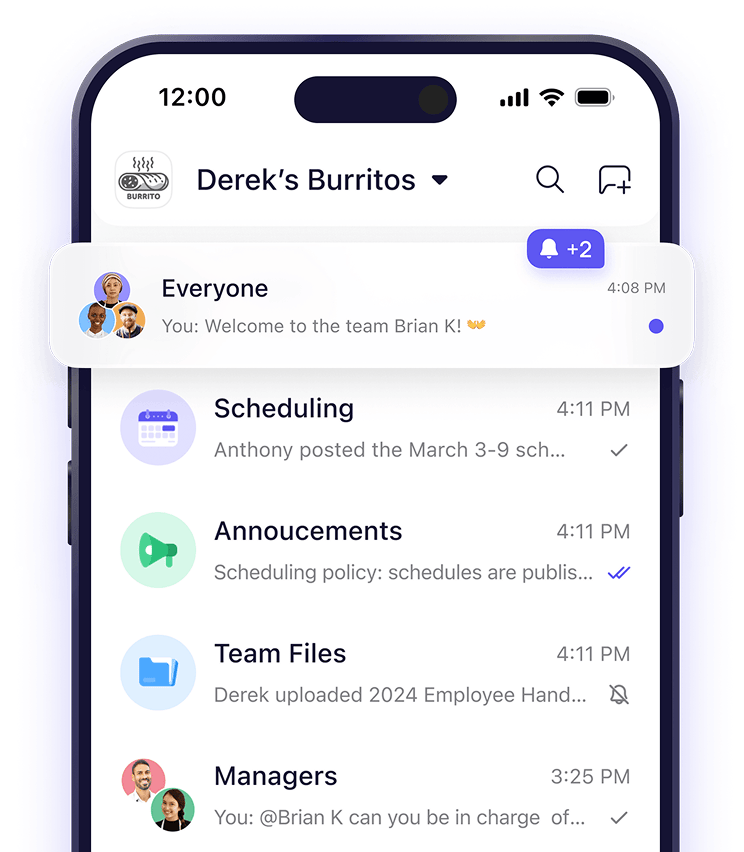
One automotive service franchise reduced staff meetings from daily to three times weekly after implementing unified communication and scheduling. When schedules and team messaging exist in the same platform, managers post open shifts, employees claim them immediately, and everyone sees updates in real time.
The compliance implications are worse than you think. Fair Workweek laws in Chicago, New York, Philadelphia, San Francisco, Seattle, and Oregon require advance notice and compensation for last-minute changes. When your scheduling system doesn't integrate with communication tools, proving compliance becomes impossible. Did you notify that employee 14 days in advance? When did they acknowledge the schedule? The proof is scattered across texts and emails you can't audit six months later when a violation claim arrives.
Compliance violations happen silently
Most basic employee scheduling software was built before Fair Workweek laws existed. The systems track schedules but don't prevent violations or calculate predictability pay.
A typical scenario: The schedule goes out 10 days in advance, meeting minimum requirements. On day 8, a manager adjusts three shifts to cover an unexpected delivery. The software allows the changes without flagging that the business now owes predictability pay. The violation accumulates silently until an employee files a complaint.
California requires daily overtime after 8 hours, not just weekly overtime after 40 hours. If your scheduling software only tracks weekly totals, managers routinely violate state law without realizing it. A cashier works 9 hours Monday, 8 hours Tuesday through Thursday, and 6 hours Friday. The system shows 39 hours, under the threshold. California law requires overtime pay for that extra hour on Monday.
McDonald's Pittsburgh franchises paid $57,332 in civil penalties in 2022 for scheduling teenagers to work excessive hours and late shifts. The violations weren't intentional. Managers facing labor shortages scheduled whoever was available, and the software didn't prevent putting a 16-year-old on closing or scheduling them for more than 18 hours during a school week.
Growth-ready systems build compliance rules into the workflow. They reject schedules that violate rest requirements, calculate predictability pay automatically, flag child labor issues before schedules publish, and track all changes with timestamps for audits.
The mobile access myth
Your scheduling software probably has a mobile app. Employees can check schedules from their phones. Problem solved?
True mobile functionality means employees can manage their work lives without calling managers. They request time off, propose shift swaps, claim open shifts, and update availability. Most employee scheduling software offers view-only mobile access with limited interaction capabilities.
This creates an asymmetric communication burden. A restaurant team of 30 generates dozens of scheduling requests weekly. Time off for a family event, shift swap for a schedule conflict, availability change for a new semester. When all these requests come through texts and calls, managers spend hours coordinating information that should flow through the scheduling system.
A nurse pulling a 12-hour shift doesn't have time to log into a web portal to request a schedule change. A retail associate working the floor can't step away for 10 minutes to call the manager about next week's availability. They need to handle these tasks in 30 seconds from their phone.
Multi-location coordination becomes impossible
Basic scheduling software handles single locations adequately. The problems emerge when you operate multiple sites that need to coordinate coverage or share staff.
A quick-service franchise with 5 locations hires 75 employees, but they don't all work at every location. Simple scheduling software treats each location as an isolated unit. Building schedules that leverage shared staff requires manually tracking who's available across multiple calendars, ensuring nobody gets double-booked, and coordinating changes that affect multiple sites.
The coordination overhead grows exponentially. Two locations create manageable complexity. Ten locations make coordinated scheduling nearly impossible without sophisticated tools. Managers resort to Excel spreadsheets and group texts to coordinate what should happen within the scheduling system.
One Taco Bell franchise group deployed Breakroom Chat across 1,000+ locations specifically to solve this problem. Their model depends on staff flexibility across nearby sites, and their previous system couldn't track availability or scheduling across the network. The result was persistent understaffing at some locations while nearby sites had excess coverage.
District managers face another challenge. They need to see scheduling patterns, labor costs, and compliance metrics across all locations. Most employee scheduling software provides location-specific dashboards but no unified regional view. District managers manually compile reports from multiple sources, delaying identification of problems until they've already impacted multiple sites.
When technical debt blocks improvements
Your scheduling software probably works for the operation you have right now. The question is whether it enables the operation you want to build over the next two years.
Growing businesses need systems that support increasingly sophisticated workforce management. Shift templates that account for seasonal variations, role-based scheduling that ensures proper skill mix, labor forecasting that prevents over and understaffing. Most basic employee scheduling software doesn't include these capabilities. You're stuck with manual schedule building that scales linearly with growth.
Integration failures create concrete operational problems. Schedules built in one system don't sync with time clocks in another, leading to payroll errors. Approved time-off requests in your HR platform don't block scheduling availability, resulting in schedules that violate approved time off. Updates need to propagate across multiple disconnected systems.
Support and development matter more than most buyers realize. If Rhode Island changes meal break requirements or Atlanta passes predictive scheduling laws, you need a vendor that updates the software proactively rather than forcing you to track compliance manually.
What growth-ready scheduling requires
Effective shift scheduling for growing businesses integrates three components that most legacy systems separate: schedule creation, team communication, and compliance management.
Schedule creation needs intelligence beyond drag-and-drop. The system should suggest optimal schedules based on historical traffic patterns, flag potential understaffing before schedules publish, and prevent common mistakes like consecutive closing and opening shifts.
Team communication can't be an afterthought. When schedules and messaging exist in unified platforms, shift changes notify affected employees automatically, open shift announcements reach available team members instantly, and managers broadcast schedule updates to specific groups.
Compliance management requires active violation prevention. Growth-ready systems enforce advance notice requirements, calculate predictability pay automatically, block schedules that violate rest period or overtime rules, and generate audit-ready reports.
The Wendy's franchise that implemented unified scheduling and communication achieved 100% compliance with Oregon's 14-day advance notice requirement not because managers became more organized, but because the system made compliance the default path.
The cost of waiting
Staying with employee scheduling software that constrains growth has compounding costs. Each quarter you delay makes the eventual transition more complicated because you have more locations, more employees, and more embedded workarounds to unwind.
Growth doesn't happen automatically because you switch to better software. But growth is constrained when your systems can't support operational complexity. Every expansion decision carries the question of whether your infrastructure can handle additional locations.
The franchises that achieve 67% higher first-quarter performance when opening new locations share a common characteristic: they implement proper systems before they need them, not after those systems become urgent requirements.
Your current shift scheduling software probably works for the business you have today. The relevant question is whether it supports the business you're trying to build. If you're planning to add locations, expand your team, or improve operational efficiency, the limitations of basic scheduling tools will become growth constraints faster than you expect.